


Carb loading meal plan, for marathon week.
Most of race week looks like a normal training week.
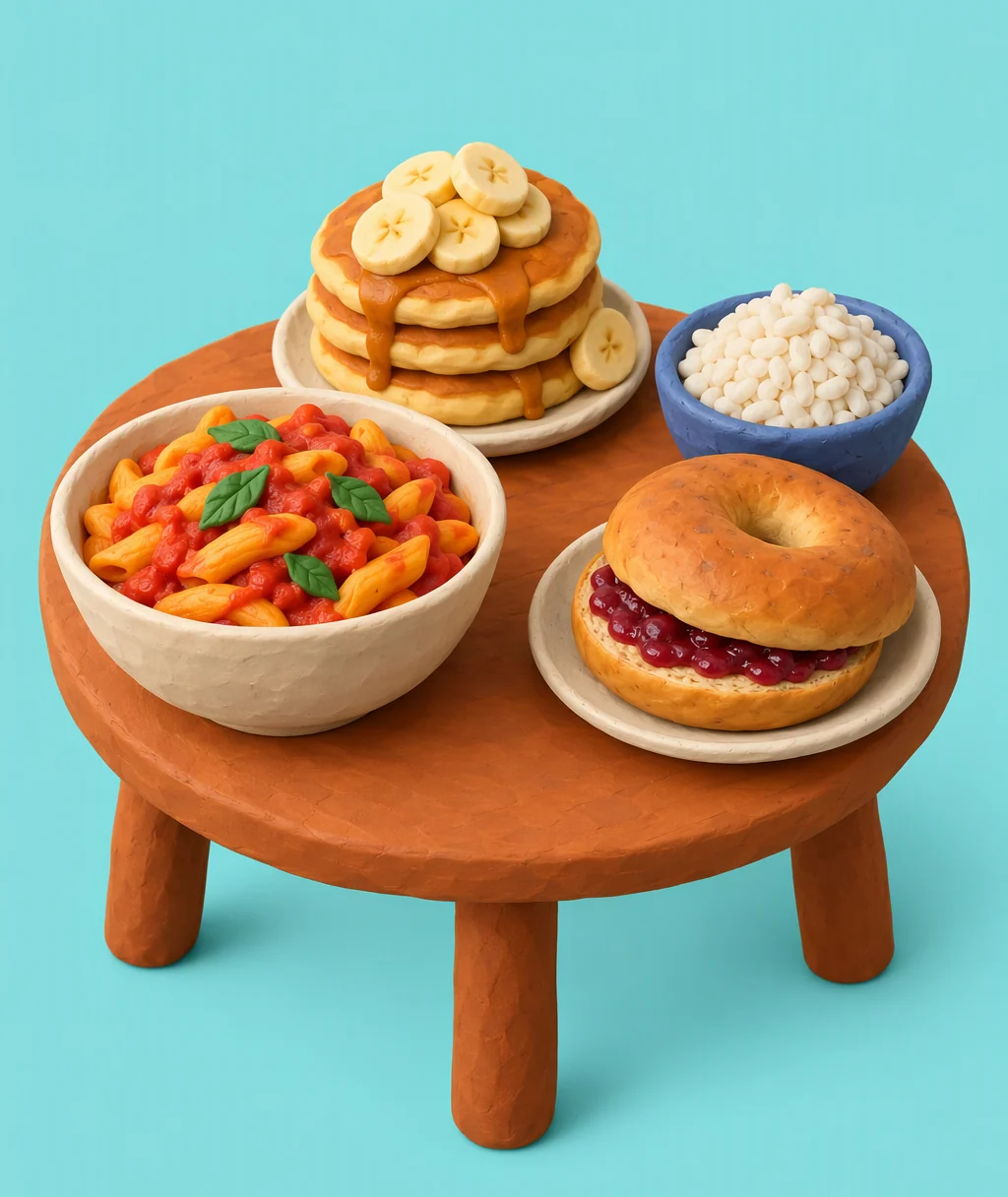

How does carb loading for a marathon work?
For 36 to 48 hours before a race longer than 90 minutes, you eat about 10 to 12 g of carbs per kilogram each day. That fills muscle glycogen, and the joint position says events over 90 minutes may benefit from higher stores. In this plan, Monday to Wednesday sit at 5.5 to 6 g/kg, Thursday steps up to 8, and Friday and Saturday reach about 10.
Reviewed November 18, 2026. SourcesThe rules
Three moves for the last two days
Load 36 to 48 hours out
Friday and Saturday reach about 10 g of carbs per kg. Monday to Wednesday sit near 6.
Less fat on load days
Juice, white rice, white bread and honey fit the carbs into about 3,300 calories.
Breakfast 3 hours before
Sunday starts with about 155 g of carbs, low in fat and fiber.
Sample week
Race week with a Sunday marathon
About 2,440 to 3,370 calories a day for a 70-kilogram runner. Friday and Saturday are the load. Scale portions to your weight. Find your number
Built from ACSM, AND and Dietitians of Canada advice.
Day 1Monday
 BreakfastBlueberry oatmeal with Greek yogurt3/4 cup dry oats cooked in 1 cup 1% milk, 1 cup blueberries, 1 tbsp honey, 3/4 cup nonfat Greek yogurt
 LunchChicken, lentil and rice bowl3 oz roasted chicken breast, 2 cups cooked white rice, 1/2 cup cooked lentils, 1 cup roasted peppers, 2 tsp olive oil
 SnackFruit, almonds and chocolate milk1 medium apple, 1 banana, 1/2 oz almonds, 1 cup 1% chocolate milk
 DinnerPork tenderloin with sweet potato and broccoli4 oz roasted pork tenderloin, 2 cups baked sweet potato, 1 cup broccoli, 2 tsp olive oil, 1 slice sourdough
About 2,550 kcal407 g carbs138 g protein
See the other 6 days
Day 2Tuesday
- BreakfastEggs on English muffins with orange juice2 eggs scrambled in 1 tsp butter, 2 English muffins, 1 tbsp jam, 1 cup orange juice, 1 kiwi
- LunchTuna pasta with peas and Parmesan1 can tuna in water, 2 1/2 cups cooked pasta, 1/2 cup peas, 2 tsp olive oil, 1 tbsp Parmesan, lemon
- SnackGreek yogurt with raisins and honey3/4 cup nonfat Greek yogurt, 1/4 cup raisins, 1 tbsp honey
- DinnerBeef and black bean tacos with rice3 oz 95% lean ground beef, 3 eight-inch flour tortillas, 1/2 cup black beans, 1 cup cooked white rice, 1/4 cup salsa
About 2,740 kcal423 g carbs149 g protein
Day 3Wednesday
- BreakfastOvernight oats with banana and chia1 cup dry oats, 1 cup 1% milk, 1 banana, 1 tbsp chia seeds, 1 tbsp maple syrup
- LunchTurkey and hummus wraps with fruit2 eight-inch flour tortillas, 3 oz roasted turkey breast, 4 tbsp hummus, 2 cups spinach, 1 cup cucumber, 1 apple, 1 cup orange juice
- SnackRice cakes with peanut butter and jam3 plain rice cakes, 1 tbsp peanut butter, 1 tbsp jam, 1 cup 1% milk
- DinnerCod with potatoes and green beans5 oz baked cod, 2 1/2 cups boiled potatoes, 1 cup green beans, 2 tsp olive oil, 1 slice sourdough
About 2,440 kcal385 g carbs124 g protein
Day 4Thursday
- BreakfastPancakes with banana and maple syrup4 four-inch pancakes, 1 banana, 2 tbsp maple syrup, 1/2 cup nonfat Greek yogurt, 1 cup orange juice
- LunchTeriyaki chicken with white rice3 oz chicken breast, 2 1/2 cups cooked white rice, 1/2 cup cooked carrots, 2 tbsp teriyaki sauce, 1 cup apple juice
- SnackPretzels, raisins and a sports drink1 1/2 oz pretzels, 1/4 cup raisins, 20 fl oz sports drink
- DinnerSpaghetti with marinara and shrimp3 cups cooked spaghetti, 1 cup marinara, 3 oz shrimp, 1 tsp olive oil, 1 slice white bread, 1 tbsp honey
About 3,040 kcal562 g carbs118 g protein
Day 5Friday
- BreakfastBagel with jam, banana and orange juice1 large plain bagel, 2 tbsp jam, 1 tbsp honey, 1 banana, 1 1/2 cups orange juice
- LunchChicken and white rice with apple juice2 oz chicken breast, 3 cups cooked white rice, 2 tbsp teriyaki sauce, 1/2 cup cooked carrots, 1 cup apple juice
- SnackPretzels, dates and a sports drink1 oz pretzels, 3 Medjool dates, 20 fl oz sports drink, 2 tbsp raisins, 1 tbsp honey
- DinnerPenne with marinara and shrimp3 cups cooked penne, 3/4 cup marinara, 2 oz shrimp, 1 slice white bread, 2 tbsp jam, 1 cup apple juice
About 3,370 kcal714 g carbs98 g protein
Day 6Saturday
- BreakfastCorn flakes, toast and jam2 cups corn flakes, 1 cup skim milk, 1 banana, 2 slices white toast, 2 tbsp jam, 2 cups orange juice
- LunchCouscous with chicken and raisins2 1/2 cups cooked couscous, 2 oz chicken breast, 1/4 cup raisins, 1 1/2 cups apple juice
- SnackRice cakes with honey and a sports drink4 plain rice cakes, 2 tbsp honey, 1 banana, 2 Medjool dates, 20 fl oz sports drink
- DinnerWhite rice with cod and soy-ginger glaze3 cups cooked white rice, 4 oz baked cod, 1/2 cup zucchini, 1 tbsp reduced-sodium soy sauce, 1 tbsp honey, 1 tsp oil, 1 cup applesauce
About 3,310 kcal705 g carbs102 g protein
Day 7Sunday
- BreakfastRace-morning bagel with honey and banana3 hours before the start: 1 large plain bagel, 2 tbsp honey, 1 banana, 1 cup orange juice
- LunchPost-race turkey sandwich and chocolate milk2 slices sourdough, 3 oz roasted turkey breast, 1/2 cup tomato, 2 cups 1% chocolate milk, 1 apple
- SnackMango with Greek yogurt and almonds1 cup mango, 3/4 cup nonfat Greek yogurt, 1 oz almonds
- DinnerSalmon rice bowl with avocado and peas5 oz salmon, 2 cups cooked white rice, 1/2 cup peas, 1/2 avocado, 1/2 cup cucumber, 1 tsp soy sauce
About 2,690 kcal420 g carbs139 g protein
Shopping list
What to buy
See the full shopping list (8 foods)
Most days

 ProteinChicken, turkey, shrimp, cod, salmon, pork, eggs, Greek yogurt, milkchicken breastsalmonegggreek yogurt


Now and then



Make it yours
This week is a sample. Alma builds yours.
- Meals fit to your goal and the foods you like
- Log a meal by photo, voice or text in about 10 seconds
- Every meal gets an Alma Score from 0 to 100

Questions
What else do people ask?
How many calories is this meal plan?
About 2,440 to 3,370 calories a day, with 98 to 149 grams of protein and 385 to 714 grams of carbs.
Friday and Saturday are the biggest days, at about 3,300 calories and 700 grams of carbs. Fat drops below 20 grams on those days so the carbs fit. The numbers assume a 70-kilogram runner, so scale portions to your weight.
What should I eat the morning of a marathon?
Eat 1 to 4 g of carbs per kilogram in the 1 to 4 hours before the start, and keep it low in fat and fiber. Sunday here is a bagel with honey, a banana and orange juice 3 hours out. That is about 155 g of carbs, or 2.2 g/kg for a 70-kilogram runner. Try the same breakfast before a long run first.
How many carbs should I take during the marathon?
The joint position gives 30 to 60 g an hour for efforts of 1 to 2.5 hours, and up to 90 g an hour past 2.5 hours. For the higher rates, it points to a mix of glucose and fructose. Practice your gels, chews or sports drink on long runs before race day.
Do I need to carb load for a half marathon?
It depends on your time. For events under 90 minutes, the joint position gives 7 to 12 g of carbs per kilogram over the 24 hours before, with no longer load. If your half marathon takes more than 90 minutes, the 36 to 48 hour load in this plan applies.
How much should I drink before the race?
The joint position suggests 5 to 10 ml of fluid per kilogram in the 2 to 4 hours before the start. For a 70-kilogram runner that is about 350 to 700 ml. Salty foods or a sports drink can help you hold on to it. Sweat rates vary a lot, so the ACSM fluid position stand recommends a plan built for you.
How does Alma help with race week?
Log each meal by photo, voice or text in about 10 seconds, and Alma shows your calories, carbs and protein for the day. The Alma Score rates each meal from 0 to 100, drawing on Harvard's Alternate Healthy Eating Index, and Alma builds a plan around your goal and the foods you like. On load days you can check that carbs reach your target.
Sources
Written by Alma from the sources below and reviewed November 18, 2026. Calories and protein are estimates. This is general information, not medical advice. If you manage a health condition or take medication, check changes with your clinician. Editorial standards
Get a week built around you.
Tell Alma your goal and the foods you like. It plans the meals and scores each one.